
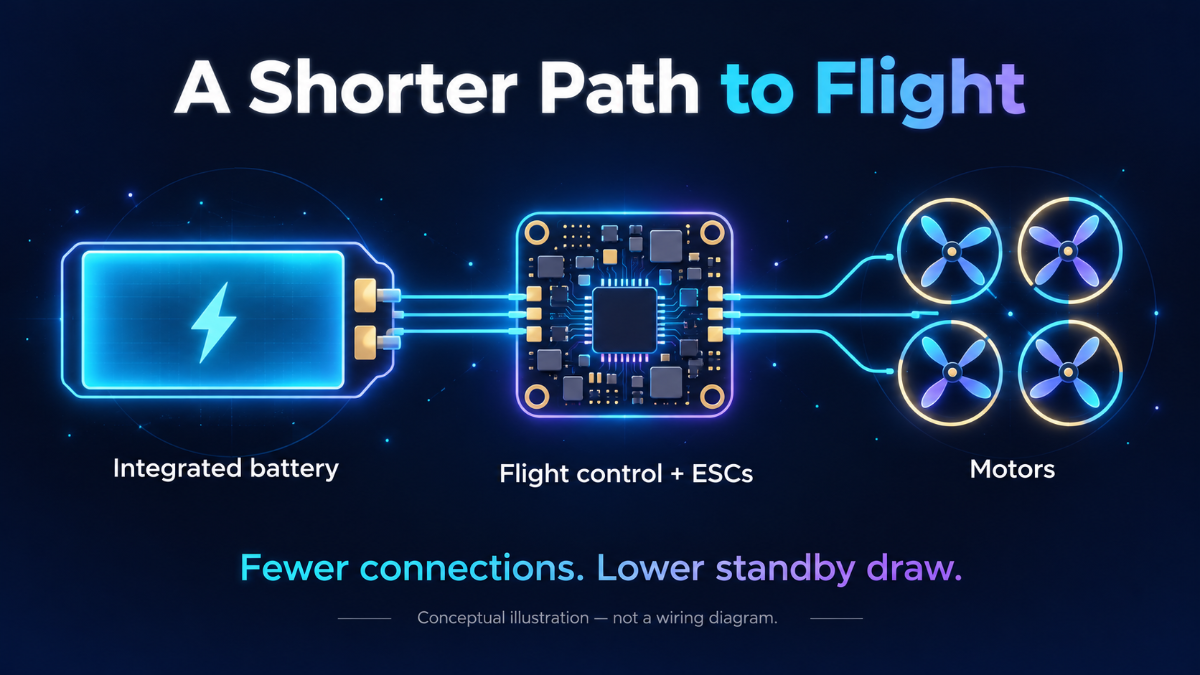

Every connection in a drone’s power path matters. That’s why we use soldered-in batteries and combine the flight controller and electronic speed controllers—ESCs—on one board.
The goal is simple: put more battery energy into flight and lose less as heat.
Fewer connections, less wasted energy
Our battery connects directly to the integrated board, which controls power to the motors. This removes the detachable battery connector and its associated cabling.
Connections and cables have resistance, which generates heat when current flows. Reducing unnecessary resistance helps preserve voltage under load and supports efficient thrust and longer flight time.
One board, a simpler power path
Integrating the brains and ESCs lets us eliminate additional power-switch MOSFETs and separate switching stages from the main power path.
The ESCs still need switching components to drive the motors. We remove unnecessary stages, reducing the places where power can be lost. Texas Instruments explains how MOSFET resistance creates conduction losses.
Microamp remote-off standby
Soldered in batteries also allows our remote-off mode to draw only microamps, keeping the electronics’ standby drain extremely low while retaining remote power control.
The design targets years of standby from the electronics’ power budget. Actual storage time also depends on battery self-discharge, temperature, condition, and starting charge. Follow the battery maintenance schedule even when standby consumption is tiny.
Installed batteries can simplify shipping
Shipping batteries inside the equipment they power can offer options unavailable to loose batteries. The advantage comes from shipping them installed—not from soldering alone.
IATA’s shipping FAQ explains this distinction. Battery testing, packaging, protection against accidental activation, and carrier requirements still apply; see its 2026 battery guidance.
For our fleet design, integrated batteries bring together efficient power delivery, low standby drain, and less battery handling.
Explore Spectra to see how the aircraft and fleet workflow work together.